

Pita Pinta Asturiana
The Pita Pinta Asturiana is an ancient chicken breed and the only breed native to the Principality of Asturias in Northern Spain. Often described as a rustic and maternal breed, we can definitively say there is nothing more “hen” than a Pita Pinta. It is our absolute favorite, and if we ever minimize our flocks to only one breed, it will be the Pita Pinta.
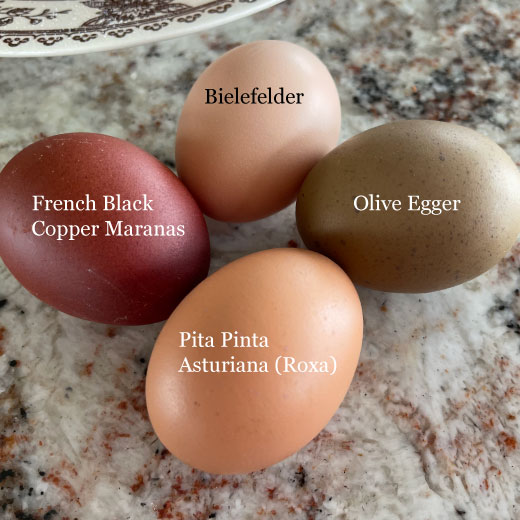
The breed comes in two colors: black and red, each with three feather patterns: white, pinto, and birchen (We keep the red variety only). Although some sources claim much greater production (Greenfire claims 250), a modest laying production found in heritage breeds of about 170 eggs per year is probably more accurate (per Dr. Marcos). The red Pita Pinta lays a toasted cream-colored egg, with a soft velvety feel to them. Chicks are pale yellow with dark yellow mottling. Their meat is prized and eaten year-round, though especially at Christmas, usually stewed or served with rice. The Pita Pinta is listed by the Ark of Taste as an endangered heritage food.
Their demeanor is calm and curious (in a word: perfect). You will not have to spend any time teaching them to take treats from your hand (they will investigate everything to see if it’s edible), and you probably will never have to chase one to catch it: they are usually already underfoot. We have never had a rooster be aggressive, and if we could keep only one rooster, it would be a Pita Pinta. They are good at foraging, but they do not require or insist on a lot of space. They enjoy their house more than other breeds and reliably seek shelter during rain or if predators are present. They do require their roosts and nest boxes to be quite low. Of the chickens that we keep, the Pita Pintas are usually the first to roost in the evening.
The effort to preserve the Pita Pinta Asturiana began in the 1980s, when Dr. Rafael Eguiño Marcos, a veterinarian and biologist, who traveled Asturias for work, began noting chickens that represented a uniform phenotype and did not correspond to improved strains or commercial hybrids. His studies were published in 1995, and in 1997, the Pita Pinta first appeared in regional poultry competitions. The Government of the Principality of the Asturias built on his work and promoted the inclusion of the breed in the Official Catalog of the Livestock of Spain, which was achieved in 2004. Prior to industrial agriculture the breed had been very common, but the Pita Pinta breed might have been lost if not for this preservation effort.
…the Asturian Pita Pinta will never compete with industrial hybrids, nor is that the intention. / Its true value in this regard lies in its ability to produce eggs under natural conditions, demonstrating its adaptation to the environment, its hardiness, and the quality of its carcasses. – Dr. Marcos
We keep the Roxa (red) variety of Pita Pintas and sourced our birds twice from Greenfire Farms, which first imported the breed to the United States in 2018. Since only a small number of birds are imported there is necessarily a bottleneck in genetic diversity on an already small population, and we fear that this may have been furthered by Greenfire emphasizing the mottling pattern and advising that white Pita Pintas should be culled.
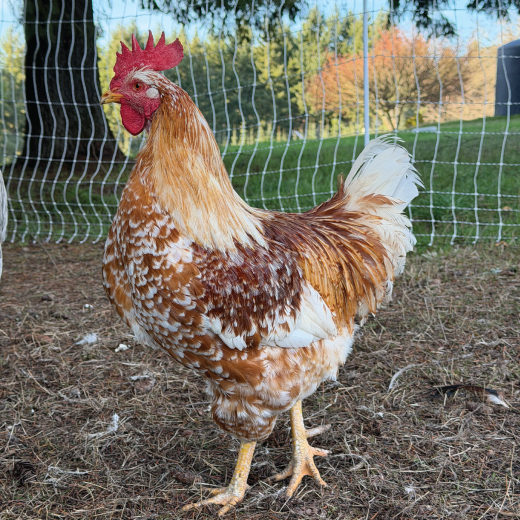
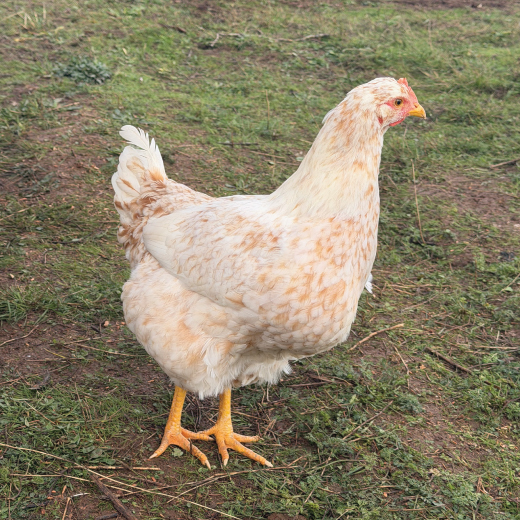
The Breeders Association of Pita Pinta Asturiana notes that a spectrum of patterns is expected from exemplary breeders, with most chicks presenting a mottled pattern, but indicates that birchen and white are acceptable and expected when breeding two mottled birds together. View the Breeders Association of Pita Pinta Asturiana Breed Standard under the heading “Capas y Mantos” to see the range of acceptable colors. Fortunately, we do have all Roxa color variations represented in our rooster flock. The white pattern presents with cream overtones and is actually very striking.
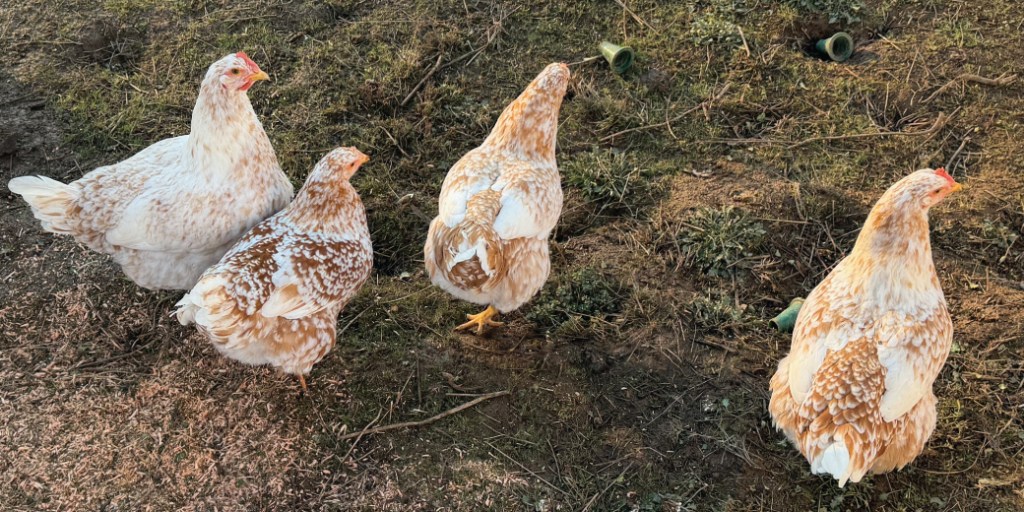
In 2025, we bred our white rooster to our mottled hens and the result was three mottled roosters in the more red shades of the breed, one darker mottled hen, one lighter mottled hen, and one white leaning hen. All Pita Pinta Roxa should be homozygous for the mottling gene whether they appear mottled or white. Note that the use of “Red” in the translated name is somewhat misleading, Dr. Marcos listed “Naranja” (Orange) in parentheses next to the name and stated:
In case there is any confusion regarding the red feathers in P.P.A. breed birds and the existence of a variety of the breed called Pinta Roxa, I must clarify that “ROXO” in Asturian defines a range of colors that, for human hair, for example, goes from blond to red.
Thus, in the Roxa variety of the P.P.A., the coat color can take on, especially in roosters, a dark or very bright orange hue, but it will never be red (“ENCARNADO” in Asturian)… – Dr. Rafael Eguiño Marcos
In Crosses or Mixes
In crosses or using the Pita Pinta in mixed breeding projects (see Sunset Highway and Red Hatchet), we have been blown away by color and type. Even when crossed with small-bodied birds like Silverudd’s Blue, the Pita Pinta lends a meaty-ness to the first generation offspring. While the mottling gene is recessive, we are also seeing interesting patterns in first generation offspring. We have not had any health issues in such mixes so far. In fact, a hen from a Pita Pinta Asturiana x Bielefelder hybrid lays an extra large dark pink egg, whereas her mother laid only large eggs, and has been one of our strongest layers. See the Hybrid and Millefleur papers under Dr. Marcos’s works below for more photographs of birds with mixed Pita Pinta genetics.
Our Pita Pinta Asturiana Roxa
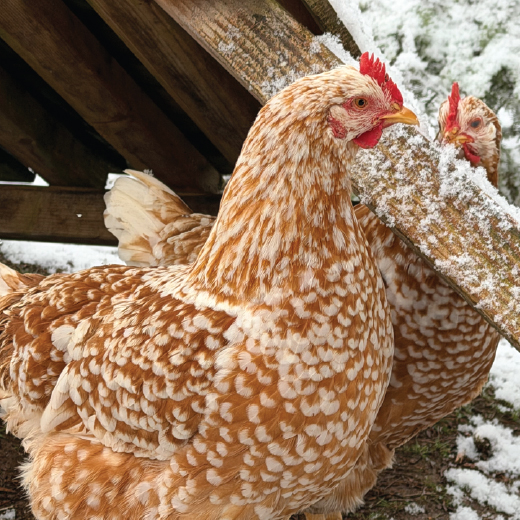


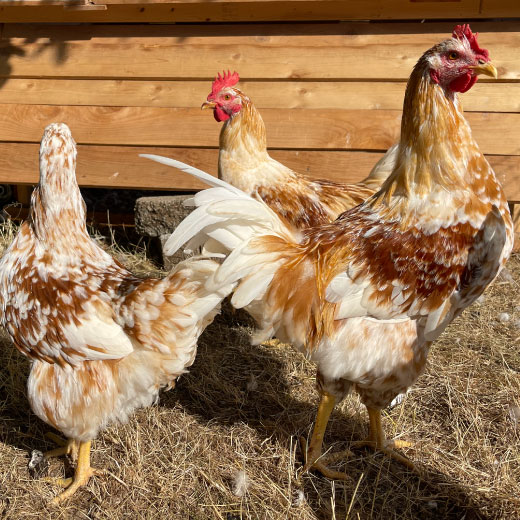


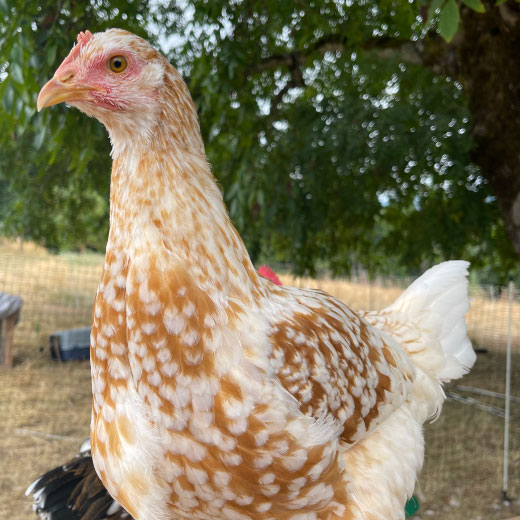


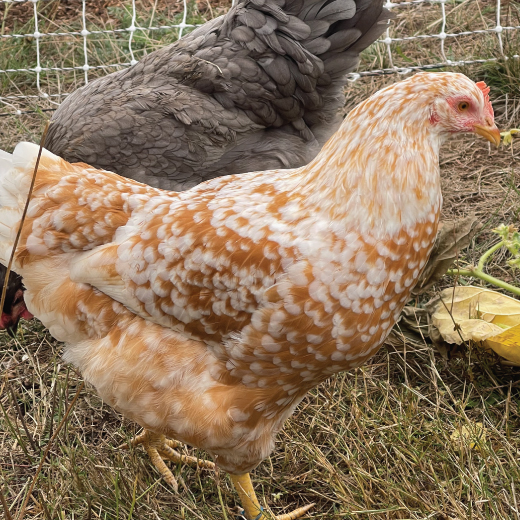



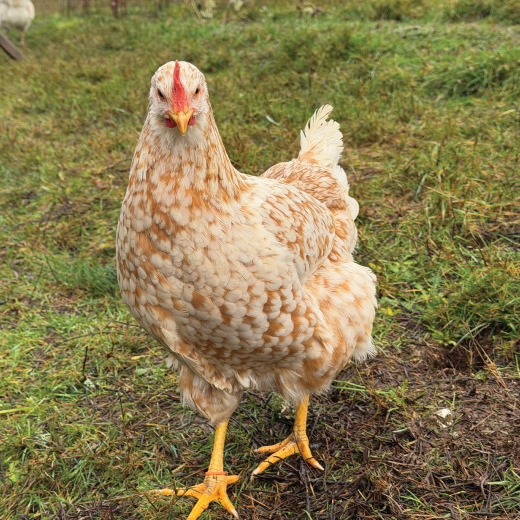
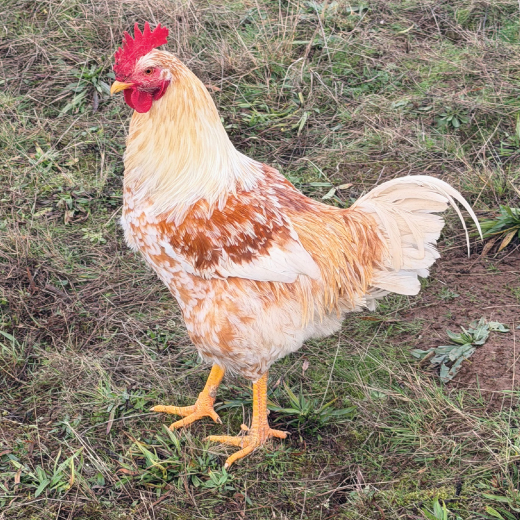
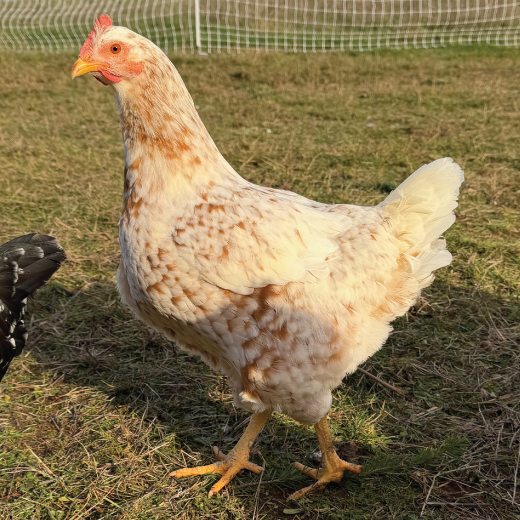
Our Breeding Status
At present, we are focused on maximizing genetic diversity. We plan to include white birds in our breeding groups and maintain the spectrum of color expected from Pita Pinta, so you may get white birds from our chicks (they will still be homozygous for the mottling gene). We suspect that the perpetual exclusion of white appearing Pita Pinta Roxa from breeding groups would result in coloring from only the darker end of the spectrum.
In 2026, we are planning to breed both one of our original roosters from Greenfire and one of our 2025 grow-out roosters who lacks the red shoulders seen in most of our roosters from Greenfire. He is on the lighter end of the variety of shades expected from the Roxa variety that presents as mottled and is mostly golden in his hackle feathers. We have three groups of hens, one from Greenfire, one out of our darkest hued rooster, and one out of our white rooster. You may receive chicks from either or both of our roosters.
In 2025, we saw chicks who hatched with chipmunk patterned down, as well as a couple of hens who feathered out to have an incorrect millefleur pattern. Please see our discussion of this below and understand that this may show up in our 2026 chicks. We will do our best to only give chicks presenting with this pattern as extras, but please understand that the pattern can be somewhat hidden. We are working to breed this out of our flock and are excluding from our breeding groups any birds presenting with the incorrect pattern as adults.
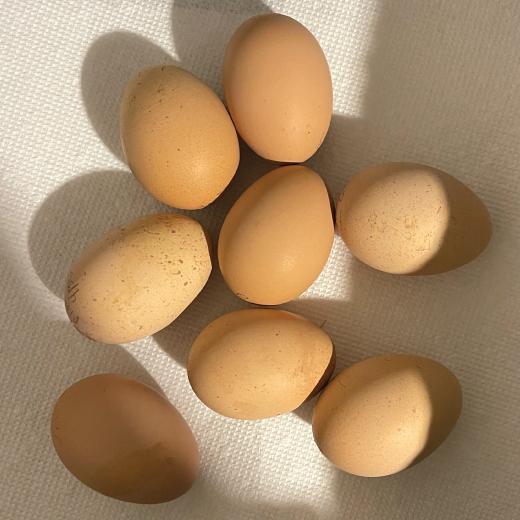
We are also seeing more color variation than we would expect in egg color in some of our Greenfire hens, (see egg collection photo) as a couple of our hens are laying a lighter color egg with dark pink speckling, still with a matte bloom rendering the egg velvety.
As a rare, imported breed with a small gene pool, we are more likely to encounter fatal genetic defects, cosmetic issues or low disease resistance. Know that rare breeds involve greater risk over hardy hybrids and diverse gene pools. One of our chicks from Greenfire struggled and was half the size he should have been at maturity, and one of our hens from Greenfire succumbed to ascites at just a year and a half old.
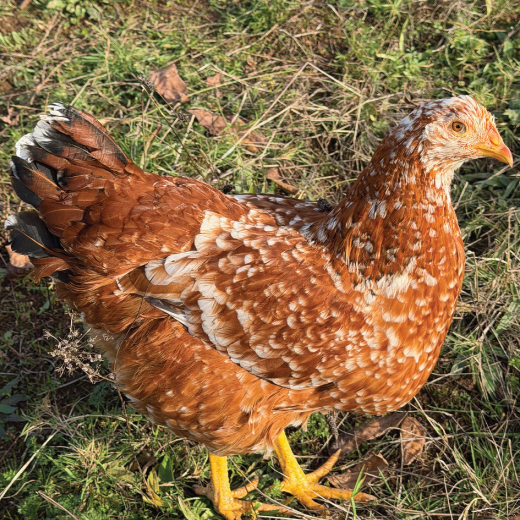
Appearance of Incorrect Tricolor or Millefleur Pattern
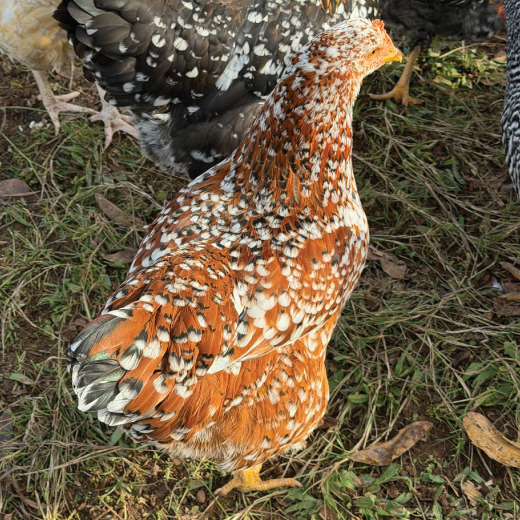
Many of the roosters we received from Greenfire had minor black leakage in their tails. In our 2025 grow-outs from our darker hued rooster, we saw hens with incorrect coloring in that their feathers were a deep red and not a dark brown-orange, and they had a millefleur pattern (a black bar between the white mottled tip and the colored portion of the feather). We have seen reports of people who received chicks from Greenfire feathering out with this pattern, and when we reached out to Greenfire they suggested that it was just a recessive gene showing up.
In researching this further, we found the website of Dr. Rafael Eguiño Marcos (see below), who has addressed this issue extensively and suggests that this pattern is showing up in populations that have been outcrossed to other breeds with a “wild type” phenotype. This makes sense to us as we noticed chipmunk patterning in the down of chicks who hatched with hints of black feathering. While there are currently listings in Europe for “Tricolor” or “Millefleur” Pita Pinta Asturiana, we note that Dr. Marcos was adamantly against it being included as a color in the breed (translated using Google Translate):
October 10, 2016 (ACPPA) The Association of Breeders of Asturian Pita Pinta, at the Infiesto Hazelnut Fair, in statements to TPA (Television of the Principality of Asturias), continues to insist on the deception of the 5th variety of the breed. I suppose they believe that a lie repeated often enough becomes the truth. Perhaps with the intention of confusing, they call specimens that exhibit the thousand-flower phenotype, which is awaiting approval, the “tricolor variety”…
Apparently, their argument is that these specimens share a great deal of genetic material with purebred specimens of the breed. I don’t know if they are trying to mislead the Expert Commission of the Ministry of Agriculture of this country. (Which, unfortunately, is within the realm of possibility.) It is true that these hybrids possess many of the breed’s genes since, as demonstrated in the section on the “thousand flowers” phenotype previously discussed, for this phenotype to manifest, the specimens exhibiting it must possess three-quarters purebred blood.
And all this without demonstrating that the phenotype has been established in a sufficiently large population, as evidenced by the 2016 Infiesto exhibition shown on TPA, where they were only able to produce two rather imperfect females, without tails or white wings, and without any males. From the perspective of respect for the Asturian Pita Pinta breed, it is SHAMEFUL. And let’s not even mention the criteria that this Association, responsible for the breed’s studbook, should have for its conservation and improvement.
Incorrect Tricolor Pattern (Presenting & Hidden)

Works of Dr. Rafael Eguiño Marcos
These works (in Spanish) of the late Dr. Rafael Eguiño Marcos, who saved the Pita Pinta Asturiana from extinction, were until very recently available on Pita-Pinta.com, which appears to be taken down, and were obtained using the Internet Archive. They contain much more detailed information and photographs than are available on the Breeders Association website below. We believe some of the genetic information may be incorrect or outdated, as the “pi” gene is now believed to be the same as “mo.” We also have some suspicion that the Pita Pinta Asturiana Roxa may carry Db and not Co. We are sharing them here for others interested in preserving and furthering the breed (or using it in breeding projects!).
El fenotipo Milfores en la Pita Pinta Asturiana
Pita Pinta Asturiana de capa Gris-azul Hibrido que posee el gen Blue (Bl/bl)
Examples of our Flock & Breeding Results
2026 Breeding Rooster (from Greenfire Farms).
Penny, our first hen from Greenfire Farms, who was accompanied by 6 (!) roosters.
White Rooster from Greenfire Farms (still homozygous for mottling gene).
2025 Grow Out Hen with more uniform mottling.
2025 Grow Out Cockerel (17 weeks), with golden hackles and lacking any hint of red shoulders. He is the only one of many cockerels we grew out that has this coloring.
2025 White presenting hen, out of White Rooster and Mottled Mother (see above, she is still carrying two mottled genes).
Hens from Greenfire Farms showing emphasized lacing versus mottling on their cushion feathers.
2025 Grow Out Pullet showing more uniform mottling and color but still shows some lacing across her cushion feathers.
Color variation in maturing pullets out of White presenting rooster and mottled hens.
Other US Breeders of Pita Pinta Asturiana (Roxa)
Guernsey Nurse Creamery – Middleburg, PA (Shipping hatching eggs)
Sullivan Family Farms – Cheney, Washington (Local Pick-up)
The Bloom-n-Hen Homestead – New Castle, Indiana (Shipping hatching eggs)
Other Breed Resources
Our Other Breeds & Breeding Projects
Elk Creek Rock Breeding Project
 Perennial Hill, LLC