
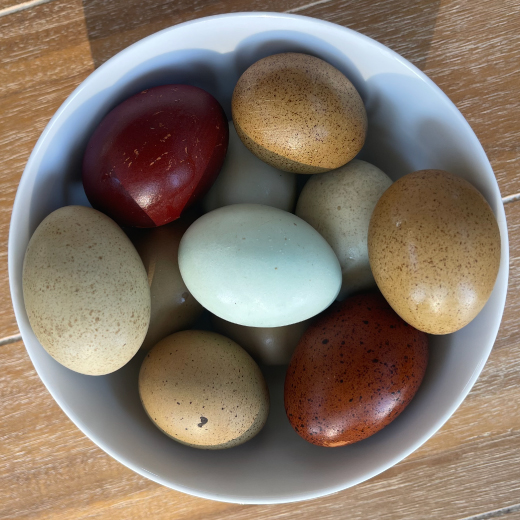
All About Egg Colors
Colorful Eggs
The genetics that determine the color of chicken eggs are very complicated, and there is still a lot that is unknown when it comes to depth of color, speckling, and bloom.
In a very simplified understanding, every eggshell is either white or blue, and that is determined by two genes. The gene for blue shells is dominant, so if a hen has one gene for blue eggs and one for white, she will still lay blue eggs. Blue eggs are not just made of calcium carbonate and other minerals found in white eggs, but also have oocyanin throughout the eggshell, which makes it blue.
What about all of those brown eggs? There are at least thirteen genes that control the level of protoporphyrin, or brown pigment, that a hen’s body may coat a white egg with, and this is how we get tinted, cream, brown, chocolate and everything in between. We think of this as “brown paint,” and we’ll refer to it here as simply “brown paint.”
If a hen lays blue eggs and also produces brown paint, then she will lay eggs that appear green. How strong the blue pigment and how dark the brown paint is will determine the shade of green.
What about gray, purple, and pink? Every hen coats each egg with a bloom (or cuticle), a mucous coating that protects the egg’s precious contents from bacteria. Often the bloom will dry clear, however, some hens have a heavy or thick bloom that appears white. This heavy bloom can make a light brown egg appear pink, a dark brown egg appear purple, and green egg appear gray. When dipped in water, the color of the eggshell under a heavy bloom is revealed.
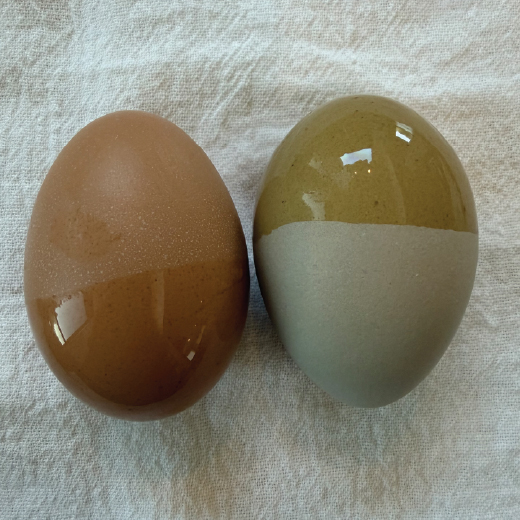
Speckling is even less understood than the factors influencing bloom. Raised speckling is often thought to be excess calcium deposits that the brown paint or bloom gets caught on, and flat speckling is thought to be a misfire or error in the brown or bloom coating process. Much of the research surrounding speckled eggs focuses on how to eliminate the occurrence of speckled eggs, as industrial egg farms want to produce eggs that are virtually identical.
So there are white or blue eggs, varying levels of brown paint (with possible speckling from paint splatter), and varying levels of clear to white bloom (with possible speckling from bloom splatter) that produce the wonderful variety of colors.
Any step of the egg creation process can be influenced by the hen’s diet, environment, age, and the season. A hen may not lay an egg with the same color, speckling, or bloom on a consistent basis. Bloom becomes clear when wet (as seen in the wet egg photo above), and brown paint can be smudged while it is drying after the egg is laid. Dried brown paint can also be sanded off to get down to the underlying white or blue eggshell color. Bloom can be removed when eggs are aggressively scrubbed, however, with our gentle washing process we see the bloom reappear, intact, as eggs dry after washing.
Silverudd’s Blue & Our Gilded Martin Project
Silverudd’s Blue (named for its feather coloration) should lay green eggs. The inconsistency in the brown paint over the blue egg, as well as variety in speckling, produce a wide variety of greens. The breed, twice imported to the US by Greenfire Farms, was unfinished at the time of Martin Silverudd’s death. The breed was not refined enough to lay 100% green eggs. The first import included some birds that only had one blue egg gene, leaving the possibility that a hen could inherit two white egg genes, and lay a brown egg. If you want Silverudd’s Blue and have high expectations, we always recommend working with a small breeder who is undertaking the arduous work of breeding Silverudd’s Blue that carry two blue egg genes and appropriate brown paint, follows the breeding guidelines from the breed association, and mostly works with first import breeding stock (second import stock is believed to have more variability in all attributes and be further from the ideal Silverudd’s Blue). They should be working to perfect the blue feather coloring and offer blue, black and splash chicks. We are offering Silverudd’s Blue chicks in 2026, but we do not claim to have top or breeding quality birds.
The inconsistent genetics in Silverudd’s Blue may explain why it has not been used widely in Olive Egger (not a breed, but a name used for any chicken that has a blue egg gene and dark brown paint) breeding. The consistent blue egg genes of the Ameraucana and dark brown genes of the French Black Copper Marans are most often used to create an Olive Egger. To achieve a dark olive egg from a typical Olive Egger cross, breeding often involves successive generations and some level of backcrossing or filial breeding to get a deeper brown paint, and in the process also produces a lot of hens who just lay brown eggs since they don’t inherit a blue egg gene.
Is there a shortcut? A hen beat us to testing out French Black Copper Marans x Silverudd’s Blue when she squirreled away some eggs and insisted she was going to hatch them. When another followed suit, we decided to let them do the work for us. The egg colors from their offspring are wonderful!

From top down: 1) green egg with brown speckling, appearing light green with lavender speckles due to a white bloom; 2) green with brown speckling; 3) olive egg appearing gray/mauve due a heavy white bloom with white speckling; 4) dark olive appearing grayish with a light white bloom; 5) darker olive due to thick brown paint; 6) darker olive due to thick brown paint with brown speckling
Both Silverudd’s Blue hens who produced the offspring laying these eggs are from Greenfire Farms. The mother of the hen laying the first two eggs lays an almost blue egg. She has little to no brown paint and typically has a heavy white bloom on her eggs. The mother of the hens laying the bottom four eggs lays a consistently green egg, sometimes with a white bloom. (Silverudd’s Blue should always have enough brown paint to make their blue eggs appear green, and white bloom is undesirable for Silverudd’s Blue since it risks the eggs not appearing green.)
If you have a dark egg laying breed, we encourage you to try breeding them with Silverudd’s Blue for Olive Egger breeding projects!

2025 Grow Out Egg Colors
We are really pleased with the colors we’ve seen in our egg collection baskets for our 2025 breeding project grow-outs!

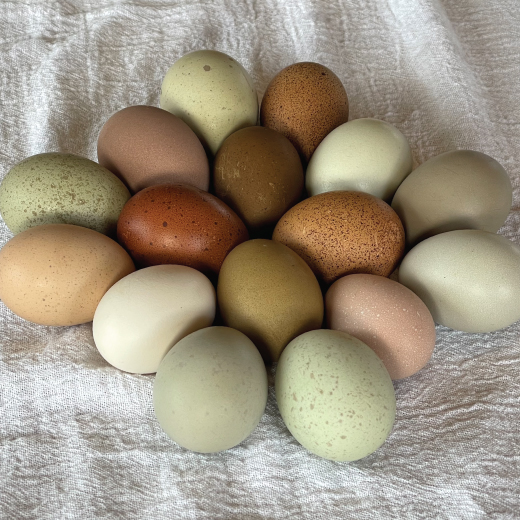
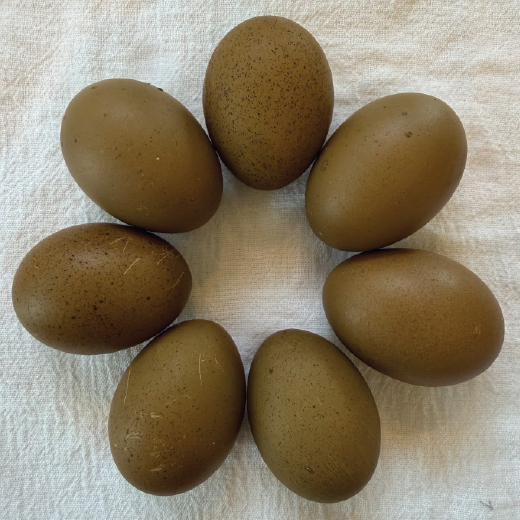
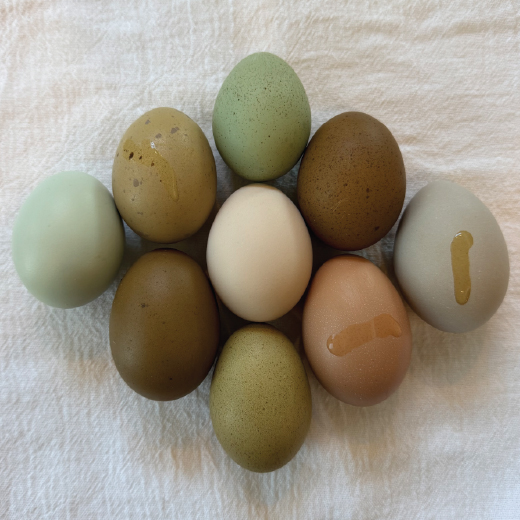
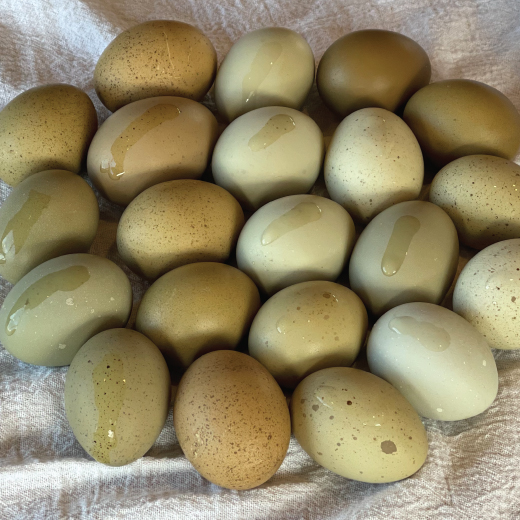
We’ve seen an increase in speckling along with more deeply pigmented greens and olives, the occasional deep army green, incredibly dark olive, and dark maroon. In general, we find the darkest layers just don’t lay all that often, so you do want to have a mix of shades to ensure your egg basket is always full! All of our breeding projects have genes for heavy bloom running through them so we often see teals, minty greens, pinks and even purple. We are also excited to see that some cream and beige eggs have come through with speckling as well.
We haven’t managed to snap any good photos yet, but we also have pink eggs with dark speckles and pink eggs with white speckling coming from some of the hens in our breeding projects (mostly Sunset Highway).
We have an Elk Creek Rock 2025 Lichen Line grow out hen that’s laying what appears to be a true blue egg – that is she didn’t inherit any brown pigment, but may have two blue egg genes. This has made us want to select for this, so we are continuing with the Silverudd’s Blue x Swedish Flower Hen mix of genetics to select for true blue laying hens under our Rising Mist Breeding Project.
In most of our breeding projects we are utilizing both mothers and daughters from 2025, and we expect hens to lay the full spectrum of possible light to mid tone shades in our Elk Creek Rock Breeding Project, with our Gilded Martin Breeding Project achieving even darker shades. For guaranteed greens (usually speckled), look to our Silverudd’s Blue. For blue eggs, check out our Rising Mist Breeding Project and for pinks and the occasional teal or minty greens, check out our Sunset Highway Breeding Pen.
If you have questions about the egg colors in our flocks or are looking for something specific, please don’t hesitate to reach out to us on our Contact Page!
 Perennial Hill, LLC