

Silverudd’s Blue*
Silverudd’s Blue was a breeding project of the great chicken breeder Swedish Småland pastor Martin Silverudd and was not fully completed when he died unexpectedly in 1986. Succinctly described as a “blue bird laying green eggs,” Silverudd wanted to:
“…create a productive, high-laying chicken breed that is cheap to operate but still has a size that makes it worth taking advantage of for its meat. That it is a good forager, resistant to weather, wind and disease, and saves its energy by not being too lively are therefore characteristics that have been historically important.” – Swedish Cultural Chicken Association
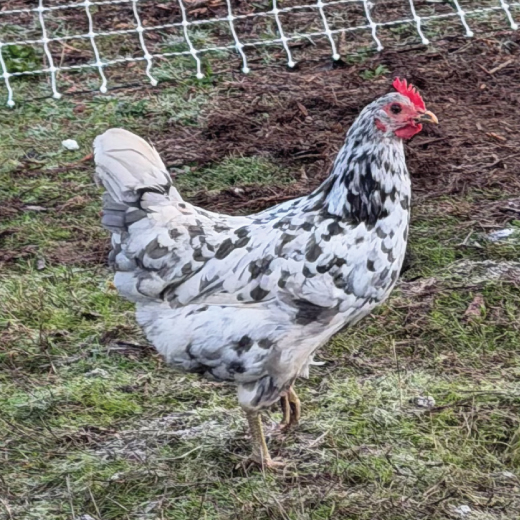
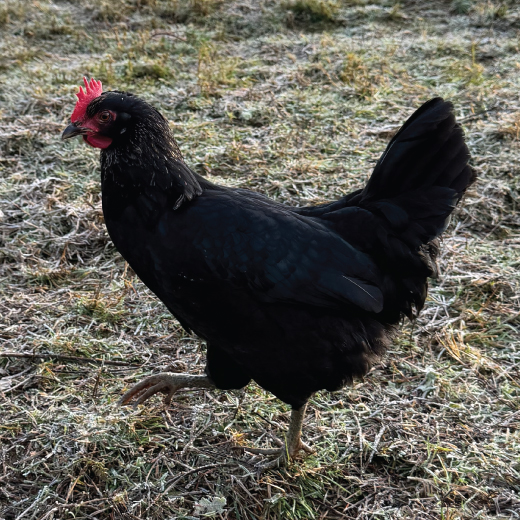
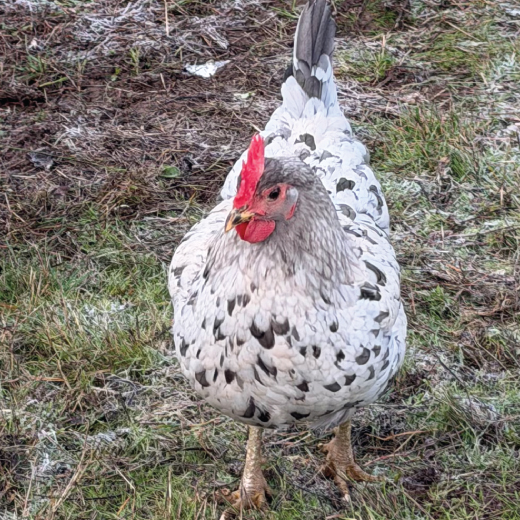
Blue feathered chickens are carrying a single blue dilute gene, and when bred together can produce splash, blue or black feathered chickens depending upon whether two blue dilute, one blue dilute or no blue dilute genes are inherited. Thus Silverudd’s Blue chickens come in blue, but also splash and black.
Initially, the breed was mistakenly called “Isbar,” another breed developed by Silverudd and completed in 1985. Some in the US still use this name to refer to Silverudd’s Blue.
Silverudd’s Blue have twice been imported into the US by Greenfire Farms, and in general many believe that the gene pool of the first import more closely matches Silverudd’s intentions:
…it has been noted that the birds from Greenfire after they brought in the Second Imports are more variable in size, color and other characteristics. Some of the characteristics are undesirable including light eyes, yellow or off-color legs, feathers on the legs, color leakage, mottling and washed out splashes, bulky and/or awkward body type (more like Marans), wrong combs (such as pea-type combs or misshapen combs), wrongly colored eggs, and a tendency to be flighty and stand-offish. Currently, all Silverudd’s Blues in the U.S. originated from Greenfire Farms and are either First Imports only or a mix of First and Second Imports. – American Silverudd’s Blue Association
In addition to the concerns over the second import stock, some have found that first import stock presented with a suppressed immune system associated with close inbreeding.
* Our Silverudd’s Blue
Our flock is comprised of two sources: the first is a small scale breeder that claims first import stock, but mostly has splash colored birds, and the second is Greenfire Farms, from which we obtained birds twice in 2023, which we assume included a mix of first and second import stock.
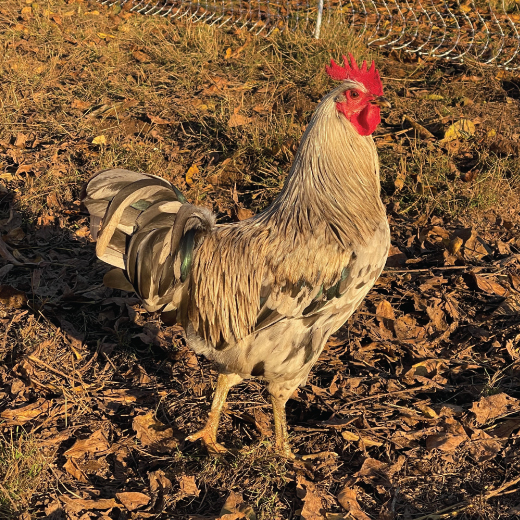
Our Silverudd’s Blue hens aren’t usually the culprits when it comes to knocking over feed or muck buckets (they simply don’t weigh enough). They are the first to rush to new forage areas when the fence line gets moved and the most likely to catch an insect mid-flight. We would not describe them as flighty, but they are certainly fast on their feet. We do not handle our birds as much as those with small flocks might, but we can see how easy it would be to get very attached to these hens who like to happily chat with us when we are in their pen. There is always a Silverudd’s Blue hen that becomes a favorite of the favorites. Our roosters have never shown any sign of aggression towards us. They seem very determined to stay out of our way. We often think of our Silverudd roosters as little sentinels: they are always looking out for danger and ready to sound the alarm. Out of all of our roosters, Silverudd’s Blue make the most noise when tidbitting and calling others over to see what they’ve found to eat – they are always very excited to share a good find!
In our humble opinion, neither source of our Silverudd’s Blue has particularly good quality Silverudd’s Blue. In particular our birds from Greenfire Farms proved not to be very hardy and were highly variable in size. We also had a hen with pea comb (albeit understated in a heterozygous form) that is the source of pea combs in our Elk Creek Rock Breeding Project, and one hen who lays a blue leaning egg due to a heavy white bloom (both are excluded from our breeding flocks). Our first import stock has incorrectly colored legs and eyes and has eggs that are nearing, but are not quite large in size. Neither group is particularly worth processing in our opinion, but we suspect that is true for most of the US Silverudd’s Blue population. Notably, most US Silverudd’s Blue are silver birchen based, and look very different from the rooster shown on the Swedish Cultural Chicken Association‘s page for Silverudd’s Blue.
We have, after looking for sources of new Silverudd’s Blue genetics, started to feel a lot better about the genes already on our farm! We have been pleasantly surprised by the chicks we hatched out in 2025. In our sourced birds none of them had dark eyes – all were hazel or orange. Breeding the supposed first import stock together, as well as crossing the first import stock to a hardy rooster from Greenfire, resulted in chicks who mostly matured with dark eyes (others are hazel, light brown or orange). We did have one hen who grew up to be a very diluted splash – almost all white, which is a concern when continuously breeding splash birds together. In our other grow outs we were impressed by the intensity of splash coloring – with almost black splashes, as well as birchen or lacing markings.
There has been special importance placed on testing for the blue egg gene in Silverudd’s Blue given that the second import stock had some wrongly colored eggs showing up. Testing is required to fully eliminate any chance of white or brown eggs since the Blue Egg Gene is dominant, and two birds could come from green laying parents, but produce offspring that lay white or brown eggs. Our breeding roosters are homozygous for the blue egg gene, and all offspring will inherit a blue egg gene from him and should lay a green (or less likely, blue-green) egg. Most of our hens have some speckling on their eggs. All of our hens in our breeding group are laying a green egg, but we cannot guarantee that they are also homozygous for the blue egg gene as we have not tested them. Feather testing can be done through IQ Bird Testing, but at $30/test, it’s not economical for us to test our hens.
In 2026, we are establishing two breeding pens, both with splash roosters. Most chicks will be splash, with a very small number of blue chicks. You may only receive splash colored chicks, but we will do our best to include at least one blue chick in your order. We do not expect black chicks this year.


Even in an established and refined SOP breed, most experienced breeders will tell you that only 1 in 100 chicks will go on to become breeding material. In other words, if you want a quad of “perfect” breeders, plan to get 400 chicks and grow them all up before you choose your breeders. And, in the case of the Silverudd’s Blue, plan to test breed a good portion of those that make the initial cut. I recently saw a post from a well respected show breeder who was raising 5000 juveniles looking for the next generation of breeders. A bit overwhelming, wouldn’t you agree? Most of us do not have the luxury of being able to raise so many birds to choose from, so we use what we have and slowly work at refining it toward the goal. – Walli’s Wisdom, Walli Johnson, American Silverudd’s Blue Association
Breed Resources
Swedish Cultural Chicken Association
American Silverudd’s Blue Association
Our Other Breeds & Breeding Projects
Elk Creek Rock Breeding Project
 Perennial Hill, LLC