
Red Hatchet
Breeding Pen
“I came to find it odd that modern pastured-poultry producers have almost unanimously adopted the bird [Cornish Cross or CRX] that was built for massive industrial confinement houses. They decry the production models of the Tysons and Perdues of the world, then forge ahead with the very centerpiece of those models: the industrial chicken itself. They sell in small quantities to local food-conscious consumers a bird intended to be sold en masse in supermarkets and fast food joints to the largely food illiterate. I have read and fully understood the reasons given for this choice — largely based on marketability and price point — yet still can’t help but wonder at it. Yes, a pasture-raised CRX chicken is better than a fecal-factory-raised bird of the same breeding, but is it really, truly, good? My vote is no.“
– A Guide to Raising & Marketing Heritage Breed Meat Chickens, Wesley Hunter of Seymour, MO, Small Farmers Journal
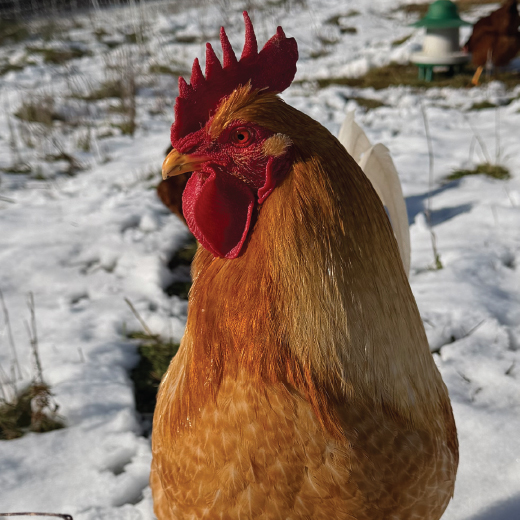
Orange Guy is the result of our white presenting Pita Pinta Asturiana Roxa rooster over a Bielefelder hen. His sister is one of our strongest layers, laying an often extra large pink egg, whereas her Bielefelder mother only laid a large egg. With a dose of Bielefelder genetics, we hope to improve on the laying ability of the Pita Pinta, as well as diversify a small gene pool. Orange Guy is calm, easy to pick up, and dedicated to his flock. When we first tried to integrate him into our bachelor flock with a group of other cockerels (intending to process him in the coming weeks), he flew over the cockerel group’s fencing and, instead of running about foraging and giving chase as others do, ran right up to us and asked to be picked up. We acquiesced to this request and have always had him in a breeding pen. He is just too good looking and too easy going not to keep around. He is a golden buff to orange color and carries a single barring gene and a single mottling gene. Half of his chicks will be barred and half of his chicks will carry a mottling gene. We are pairing him with a group of Buckeye hens in 2026.

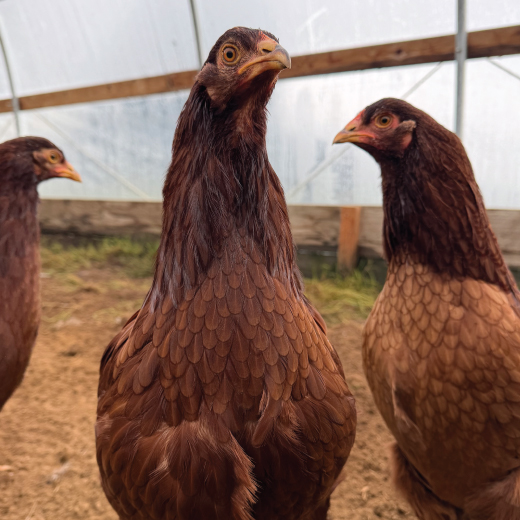
In our 2025 Red Hatchet Breeding Pen, we’re pairing Orange Guy with a group of Buckeyes: a heritage dual-purpose breed admitted to the APA in 1905 and the only breed admitted that was developed by a woman, Mrs. Nettie Metcalf of Warren, Ohio. They have a pea comb and are red with a black tail and a body type was intended to match the Cornish, without using the Cornish to develop the breed. They have a reputation for being active birds and being as good at mousing as cats. They are known to be friendly, though the occasional male is too aggressive during mating season. We are hoping to temper, just slightly, the activity and male personality of the Buckeye with our Pita Pinta. Buckeyes are very strong layers and lay a medium to large brown egg.
Chicks from this pen will be dual-purpose, and we expect that most will exhibit hybrid vigor in their laying ability. For those who are interested in raising heritage style meat birds or are working on your own dual purpose breeding project, we think chicks from this pen will be a fantastic selection to add in or start with. We are offering discounts for larger orders from this pen in support of those raising their own slow-growing meat birds.
We expect feather coloring to be variations of buff, orange, and red with black or white patterned tails/columbian like markings. We expect these chicks will take longer to reach maturity at 6-8 months, as is expected with heritage birds. This is important when raising males for meat, as they are less likely to begin sparring (and creating bruises or wounds), giving you a clean, sizable carcass by the time you process.
If you allow offspring from these chicks to interbreed, you can likely achieve mottling in about 25% of chicks as long as you carefully select your rooster(s), who will need to be carrying a mottling gene (Mottling is recessive and requires a two genes to appear in feathering). During the juvenile stage, chickens who are carrying a single mottling gene will often show signs of it with white tipped feathering before it disappears in their adult feathers (though we have seen it show up during molting as well).
Buckeye Breeding Hens Photographed at 17 weeks

Heritage Meat Bird Resources
Buckeye Chicken, The Livestock Conservancy
Our Pita Pinta Asturiana (Roxa)
A Guide to Raising & Marketing Heritage Breed Meat Chickens, Wesley Hunter of Seymour, MO, Small Farmers Journal
Our Other Breeds & Breeding Projects
Elk Creek Rock Breeding Project
 Perennial Hill, LLC