Dry Farming: A Primer
Simply put, Dry Farming is growing crops during a season without rainfall and without irrigation, with the caveat that crops may be watered in at planting or watered prior to transplanting if they are not direct-seeded. A lack of excess water in the produce itself helps to create that famous Dry-Farmed flavor.
We practice Dry Farming during Western Oregon’s hot and dry summers, starting many of our plants indoors or under protection and keeping them watered with harvested rainwater while we wait for the temperatures to rise. Once transplants or seeds go into the ground, we do our best to keep the winter moisture in the soil, keeping the surface loose (we do use some natural mulch, however, this can be dangerous in disguising gopher/vole activity until actual crop loss occurs). We seek to ensure that any water stored in the soil is available to our crops and not lost to surface evaporation or used up by competing plants.
Perennial Hill is blessed with deep loess soils that, when cultivated and dry, turn to dust but have the potential to hold onto enough water to carry crops through the dry season. The sloping foothill also lacks a restrictive layer of rock or gravel or sand through which water would readily drain or roots would not be able to penetrate. Adjacent farms are planted with hazelnut trees or wine grapes.
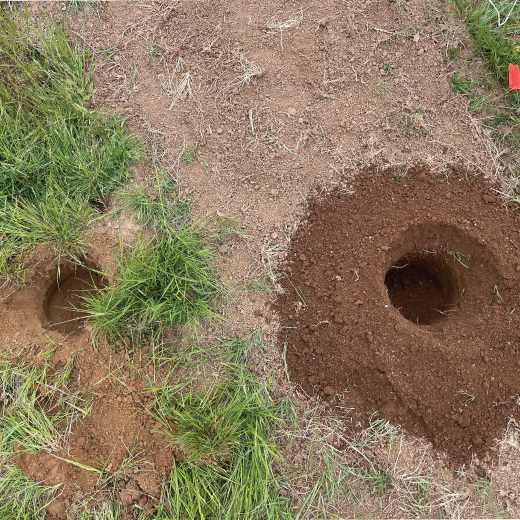
In this photo, you can see just how important field preparation is. Taken May 23, 2025, in the hole on the left the soil was rock hard and already mostly dry, as the grass had already used up the available soil moisture. In the hole on the right, a strip of soil had been power harrowed (to a depth of about an inch or two) a couple of times in the spring to create a cleared, level path for our deer fence installation. Although dried on the surface, and even with some grass still surviving, the soil remained moist, soft and pliable (helpful for fence post digging!).
We have found that tilling in our cover crop as early as the weather allows, and then following up with the power harrow – perhaps a couple of different times – helps us end up with preserved soil moisture by the time we put our plants in the ground. If there is nothing growing, the soil moisture is mostly there waiting to be used. The action of the power harrow helps to tamp out any air introduced by tilling, as well as removing any weed seedlings that sprout.
Without rainfall or irrigation, the crops must extend their root system deeper to reach water as the top levels of the soil dry out. This is where the variety becomes very important: varieties that have been bred to be productive in quick draining, regularly irrigated soil may not have the aggressive rooting habits or resiliency needed to survive a hot summer without irrigation.
Dry Farming is not for the faint of heart. Successful practices may differ region to region, property to property. Finding the best practice for a site may take time, and unpredictable weather makes it harder. Typically, dry-farmed crops need to be set further apart than irrigated crops, so not only will there be fewer plants, but each plant will likely have a lower yield, either in weight or number, or both. Field preparation and planting date are absolutely crucial, and a misstep there can impact the entire season with no opportunity for correction.
In spite of all of that, the promises of superior flavor, of low-impact farming, of the ability to grow food without having to pump water from the ground or redirect surface water for irrigation, and of farming in harmony with our climate, are what drive us to chase this practice.
At Perennial Hill, we have been experimenting with dry farming on our site since 2022. We have shared some of this experience on our Promiscuous Oaxacan Pink Tomato page. We are happy to connect with anyone interested in or practicing dry farming at any scale – just reach out!
Dry-Farmed Tomatoes
If you live in a region with a hot, dry season, we encourage you to try growing dry-farmed tomatoes! This publication covers methods for dry farming tomatoes on California’s central coast, and is a good introduction, however, best practices for Western Oregon likely differ. Check out OSU’s various tomato trials here. In our experience on our hot, sun and wind exposed site, we are finding that slightly closer spacing allows plants to protect each other, reducing plant stress. We experience high rates of sun scald, which we are hoping to mitigate through intercropping with taller and earlier season crops. To read more about our experience dry farming tomatoes and our variety trials, see our Promiscuous Oaxacan Pink Tomato page.
OSU has identified some tomato varieties that performed better under dry-farmed conditions in Western Oregon, and many are available through Adaptive Seeds, but do not be afraid to try other varieties!
For anyone serious about dry-farming tomatoes, two research papers are absolute must reads (revelatory in the insight into successful dry-farming practices at individual farms and insight into the importance and establishment of fungal communities in soils that aren’t irrigated):
Deep nutrients and soil fungal communities support tomato fruit yield and quality in dry farm management systems – Yvonne Socolar et al.
Dry Farming Resources
To really learn about Dry Farming, you can delve deep with OSU’s Dry Farming Accelerator Program curriculum.
If you want to assess a site’s potential for Dry Farming, utilize the USDA’s Web Soil Survey as a starting point. Note that this will show you what is probably below ground, but only a deep core sample and someone who really knows what they are looking at (a soil scientist) can you tell you for sure. Using the soil profile that probably exists based on the USDA’s Soil Survey, you can use the Soil Available Water Holding Capacity Calculator (linked at the bottom of OSU’s Dry Farming Accelerator Program curriculum) to rate a specific soil profile’s potential for Dry Farming.
Adaptive Seeds Dry-Farmed Varieties
Deep nutrients and soil fungal communities support tomato fruit yield and quality in dry farm management systems – Yvonne Socolar et al.
OSU’s Dry Farming Accelerator Program curriculum
John Widtsoe, Dry-Farming : A System of Agriculture for Countries under a Low Rainfall, 1911 (also available as free text online)
Steve Solomon, Growing Vegetables West of the Cascades, 35th Anniversary Edition: The Complete Guide to Organic Gardening (includes brief advice for dry farming specific produce)
Oregon State University’s Dry Farming Resource Hub (We note that variety trial information seems to be increasingly hard to find. For instance, if you swear you once saw a dry-farmed potato variety trial from OSU, you are better off searching on a search engine and not on OSU’s website).
Dry Farming Collaborative’s YouTube Channel – We especially like Dr. Michael Kotutwa Johnson presents on Hopi Dry Farming: 2000 Years of Resiliency, just one example of a resilient farming method that has been practiced for millennia.
Organic Dry-Farmed Tomato Production on California’s Central Coast
 Perennial Hill, LLC