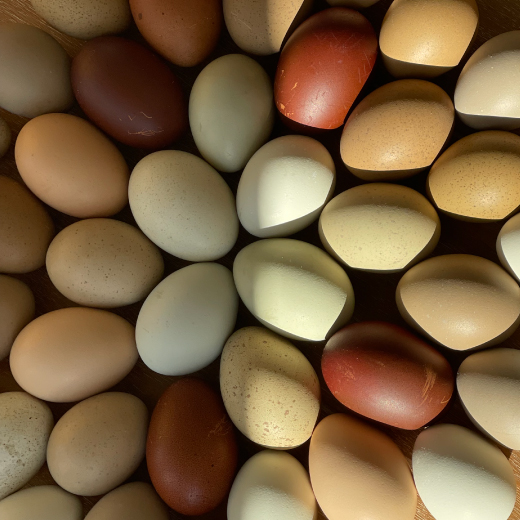
Field-to-Door Eggs
Order for Delivery
We offer eggs via delivery every Friday 8a – 11a to Forest Grove, Gales Creek, and Banks addresses. You can place your order on our Grownby.com page. Orders must be placed by Wednesday of each week for Friday delivery. Our eggs are refrigerated and must be kept refrigerated, so you must be home to receive them.
Flexible Egg CSA
After you’ve given our eggs a try, if you want to make a longer term commitment to buying delivered eggs from us, you can sign up for a flexible CSA and pay via cash or check. We’ll give you the discount gained by not paying transaction fees (4% + 0.30/transaction adds up!), and you’ll get first dibs on eggs in the event we run low due to extreme weather etc. If you prefer to pay by card, that’s fine too, but the fees will be added onto the cost. Want to sign up for 4 dozen once a month, every week, every other week? You’ve got it. Want a fresh dozen weekly, but want the discount and don’t want the hassle of ordering every week? Just want to pay in cash every week? We can do that! You tell us what works for you, and in most cases we’ll be able to make it happen. If you want to cancel or skip a week at any time that’s fine, just let us know the Monday prior to delivery. We aim to keep our pricing down, but they are subject to change depending upon feed prices. We’ll be sure to give you advance notice of any changes.
Reach out to us on our Contact form and let us know what sort of Egg CSA works for you, as well as your name, delivery address, phone number & email.
Pricing
When ordering on our Grownby.com page, our eggs are $12/dozen & delivery is *included*!
When you sign up for a Flexible Egg CSA and pay by cash or check, pricing drops to $11 for the first dozen and $10 for each additional dozen in the same delivery. Our eggs will be good for over 30 days after delivery, so consider whether having less deliveries and buying more at once will work for you!
We see delivery as a shared cost between us and all customers on a delivery day. We aren’t driving to a farmer’s market far away or paying a stall fee, and instead of 30 different families each driving all of the way out to our farm, we’re making one efficient trip!
Veg & Plant Add-Ons
We sell veg, flowers, & plants at Hollywood Farmers Market in Portland starting in Mid August and running through the fall. As a local egg delivery customer, you’ll also have the option to add on a selection veg & plant offerings to your order. We envision this starting mid-summer this year, but we are working toward offering it to our delivery customers year-round! If you want to get more local, nutritious veg in your diet but aren’t ready to join a CSA and can’t make it to the farmer’s market on Saturday – here is an opportunity!
Our Chickens
Our chickens are a little different than other pastured small-scale egg producers. Rather than a single flock of several hundred or thousand, we keep small, naturally sized flocks of 6-20, always with a rooster to dote on and protect the hens. We also don’t keep the extreme production layers who develop health problems after a couple years of laying. You can read more about our breeds and breeding projects on our Understory Chickens page.
We feed our chickens certified organic, no-corn, no-soy feed, and periodically rotate them on pasture/in forest. Currently, our chickens are “working” on our farm to improve soils where we are planting a polyculture fruit orchard. We also provide them with seasonal greens grown specifically for them, as well as unmarketable produce from our crops and special treats like sunflowers and cherry tomatoes. They eat lots of insects, worms, slugs, and the occasional vole or field mouse – chickens are not vegetarians!
We want to be transparent, so we will share that our chickens don’t have constant access to lush pastures or hedgerows – our soil has low organic matter so that mostly doesn’t exist on our property until after the chickens have spent a good bit of time there. If chickens have spent an extended time in one location, we take the opportunity to power harrow the soil and plant cover crop/forage crops/add carbon rich mulch when the chickens are moved to help keep their nutrients cycling in our soil. We do bring our chickens mature leafy greens to eat to ensure that they always have foraged greens in their diet.
Long-term, we are planning and planting a dedicated chicken orchard – full of understory trees and hedgerows – where deciduous plants will build up a soft forest floor – an ideal environment for insects and other small creatures. That’s what chickens really want – soft ground to scratch in, protein rich insects to chase and catch, and cover from predators that is easily accessible. Pasture is actually a very unnatural environment for chickens, and that’s why you’ll see them huddled near the mobile house or confined to “chicken tractors.” They are extremely vulnerable to aerial predators in an open area. To enrich our existing pasture environment for our chickens, we cut tree branches and shove them into the ground to create faux shrubs/hedges for each group. The chickens never seem happier than when they are resting under the foliage, and they never have too far to run for cover if the rooster sounds the hawk alarm!
Respecting the Chicken
Almost all commercial egg layer hens are processed for meat at 1-2 years old, as the drop off in egg production at that age leads to them not being profitable due to feed costs. We are aiming to keep the majority of our hens for 3 laying seasons, longer if we think they are important for breeding. When it comes time for a hen to “retire to the freezer,” we are committed to on-farm slaughter and processing, as being transported to processing facilities is actually the most stressful part of their last day.
We also aim to work towards relying on our own breeding to maintain our flocks. Hatching our own eggs means 50% of the chicks are born male. At industrial hatcheries, most male chicks are killed after being sexed (though new technology may simply cull the male eggs during incubation instead). We think raising the males to maturity for meat (and sometimes breeding) is a much more purposeful life. We are not offering meat for sale at this time, but we hope to in the future!
Q&A – We’ve tried to think of everything, but if you have any other questions, please reach out!
Sizing & Grading:
You can expect each carton to be generally equivalent to a dozen Large eggs, but you’ll be receiving a variety of sizes. Our sizes range from Medium to Jumbo+, but average Large, and we always try to pair medium eggs with extra large ones. Some cartons you receive will be just under 24 oz and some may be over.
We don’t weigh or grade our eggs, so you’ll see that our label uses the word “ungraded”. Eggs that are as fresh as ours are generally AA quality due to air cell, yolk, and white quality, however, we don’t exclude eggs simply because they have a blood spot in them (every once in a while one shows up), and in some cases, we wouldn’t be able to see the blood spot upon candling because our eggs’ shells are so thick/deeply colored.
What are these crazy egg colors?
We have breeding projects that focus on egg color – chicken genetics are wild! You can read more about egg color genetics on our page All About Egg Colors. Everyone loves the really dark eggs, but those hens don’t lay very often – so don’t expect that you’ll get more than more really dark egg per box – we try to give everyone a variety of colors!
Are your eggs fertilized?
Almost always! You may notice a small white bullseye on the yolk, which indicates that there is DNA from the rooster in there. There is essentially no nutritional difference versus a non-fertilized egg, but it does mean that the hen had a rooster protecting her from aerial predators and pointing out the best foraging opportunities to her. A chick won’t start forming in a fertilized egg until a mama hen (or an incubator) provides consistent warmth and humidity (around 100 degrees and 50% humidity).
Are your eggs washed/refrigerated?
Yes, we wash and refrigerate our eggs. We follow Oregon Farm Direct rules for handling eggs.
Doesn’t washing the eggs remove the naturally protective bloom?
Not necessarily – some wash methods have actually been shown to preserve the bloom (see ATTRA below)! At industrial egg farms, they may have machines that are using synthetic solvents to strip stains off of white eggs, and then recoat the eggs with mineral oil – yikes! In contrast, we have a very gentle washing process, and if an egg doesn’t immediately come clean we discard it. Because many of our eggs have a heavy bloom, we can tell that the bloom is still intact after washing by the color to which the egg dries. Not every egg comes out of the nest perfectly clean, and, by washing our eggs, we maximize the number of “sellable” eggs, which is important for our thin margin. We always carefully monitor water temperature to ensure wash water does not penetrate the shell. If you want to learn more about egg handling, we recommend ATTRA’s publication on Small-Scale Egg Handling.
Are your chickens vaccinated?
First, we’ll say that we aren’t against vaccinations in general, but chickens live too short of lives, are too easy to breed (for resistance), and present too small of margins for farmers to spend money on vaccinations. Most vaccinations for chickens serve to prevent diseases to which chickens raised in confined, inhumane environments would be extremely susceptible. It’s the inhumane conditions that would make us not want to eat those eggs – not the vaccinations. We have a few older rare breed hens that were vaccinated for Marek’s disease (around mostly for breeding and not for producing table eggs), but almost all of our hens were hatched on our farm and were not vaccinated. We brought in some hatchery stock last year: they were also not vaccinated, and we don’t plan on vaccinating our chickens in the future.
Why can’t I peel these eggs?
Eggs that you buy at the grocery store are pretty old, and a lot of air has penetrated the shell and the egg white typically shrinks a little. In a very fresh egg, there’s little air inside, and the membrane is very adhered to the egg white. Fresh eggs definitely require a special approach to boiling & peeling (using older eggs is one) – we don’t have a specific method to recommend – if you have a reliable one, please let us know!
Why are your eggs so expensive?
The major factor in our egg cost is feed. We feed certified organic no-corn, no-soy feed, and the feed cost per dozen is about $4-6. Not only is this 30-50% more expensive than conventional feed, but it is more expensive in Oregon than other areas because fewer farmers here use organic feed, and feed has to be shipped from feed mills in California or Washington. Our farm operation is too small and young to justify getting certified organic, but we hope to get there someday. In the whole state of Oregon there are only 6 certified organic egg producing farms (https://organic.ams.usda.gov/integrity/)!
After feed, there is the cost of raising each hen to laying age – that’s 5 to 7 months of care and feed before she starts laying eggs, then there’s the cost of housing, fencing, egg carton cost, delivery, transaction fees, our labor caring for the chickens, and hand collecting, washing, candling, and packing eggs. Our profit margin on eggs is small, but the value we put on being able to trace our the compost we use for our vegetables back through our chickens and their feed to certified organic grain & pulse farms & farmers is high!
Why don’t you just feed local non-GMO?
We added chickens to our farm in order to produce our own compost, which we dearly need to improve our soil’s organic matter for vegetable production. Bringing in bulk compost from CAFOs where we would be horrified by the treatment of the animals or municipal compost full of suburban yard herbicide, fertilizers, pollution, and microplastics from car tires – those routes didn’t feel like honoring our land, so we’re taking the long way around. Feeding local non-GMO feed would also be a shortcut.
Local non-GMO feed has a pretty good reputation around here, and the phrase “not sprayed during the growing season” often gets bandied about. What that really means, is that the feed is still conventionally grown: grain fields may be sprayed with synthetic herbicides/pesticides before/at the time of planting, synthetic fertilizers are used freely, and crop seeds treated with synthetic pesticides/herbicides/fungicides like neonicotinoids may be used. Non-GMO that isn’t organic is still conventionally grown. Organic > non-GMO: the use of GMOs is always prohibited in organic practices.
By feeding organic feed, we know that someone is checking that those farms aren’t using synthetic inputs (and have NOT used them in at least three years!), are utilizing crop rotation and caring for their soils. We feel good about being connected to those farmers and that land and supporting the growth of organic farming.
Aren’t you worried about organic grain fraud?
Oh my gosh, Yes! But, we can either buy certified organic feed and know that there is some risk that some of it isn’t actually organic, or we could just buy non-GMO feed, and know that synthetics were used. We support the work of the Real Organic Project and the strengthening of the organic certification system.
Please contact your congressional representatives and tell them that you’re upset that you can’t 100% trust the USDA organic label and that you support American Organic grain farmers and the Organic Imports Verification Act of 2025!
 Perennial Hill, LLC